


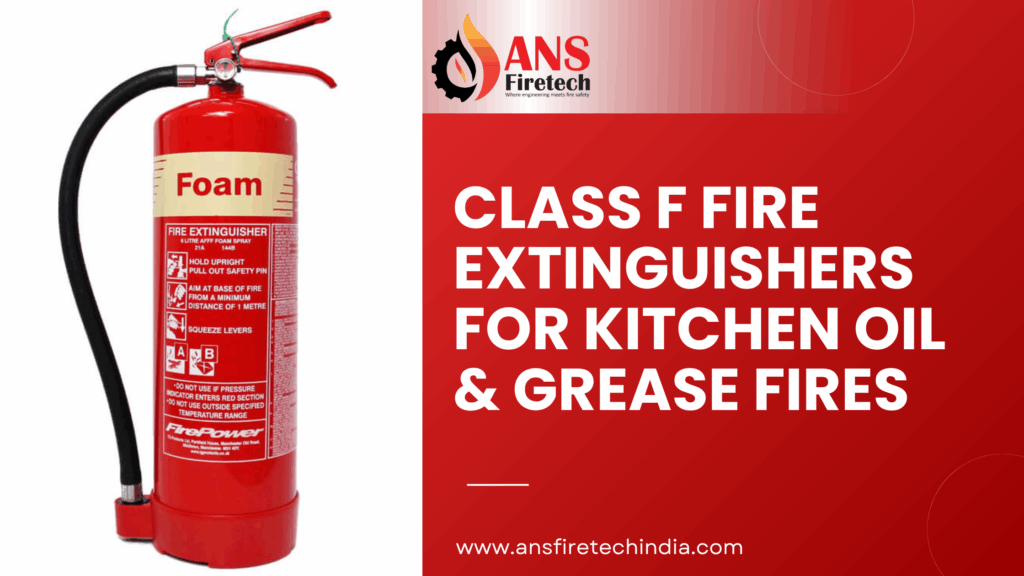
Kitchen fires are among the most deadly and quickly spreading forms of fires when it comes to fire safety. Oil and grease fires can start in a matter of seconds and can become a serious hazard in any type of kitchen, including commercial restaurants, hotels, cloud kitchens, and even your personal kitchen. The Class F Fire Extinguisher is essential in this situation.
We’ll go over everything you need to know in this tutorial, including what Class F fires are, why they occur, how to put them out, and how to keep safe.
What Is a Class F Fire?
A Class F Fire (also known as Class K Fire in some countries) refers to fires caused by hot oils, fats, and grease — commonly found in:
- Deep fryers
- Cooking pans
- Commercial fry stations
- Industrial kitchen equipment
- Household kitchen stoves
These fires burn at very high temperatures, making them hard to control with regular extinguishers.
Why You Should Never Use Water on Oil or Grease Fires
Pouring water on burning oil is a common mistake made during kitchen fires.
However, water makes the flames burst and spread.
The water immediately turns to vapour as it drops beneath the hot oil, scattering the burning oil all over the place and intensifying the fire.
So remember:
Water = Explosion when used on oil fires.
What is a Class F Fire Extinguisher?
A Class F fire extinguisher is specifically made to use a wet chemical solution to put out oil and fat flames.
This chemical cuts off oxygen and lowers the temperature when it combines with the burning oil to form a soapy cooling layer.
Key Features:
| Feature | Benefit |
|---|---|
| Wet Chemical Agent | Smothers fire + cools oil quickly |
| Designed for High-Temperature Oils | Works where other extinguishers fail |
| Minimizes Re-Ignition | Prevents fire from starting again |
| Safe for Kitchen & Restaurant Use | Ideal for cooking environments |
Where Should Class F Fire Extinguishers Be Used?
| Place | Reason |
|---|---|
| Restaurants & Cafés | High usage of deep fryers & cooking oils |
| Hotels & Resorts | Continuous kitchen operations |
| Food Processing Industries | Large-scale oil heating systems |
| Canteens & Mess Kitchens | High-volume meal preparation |
| Home Kitchens | Protection from accidental pan fires |
How to Use a Class F Fire Extinguisher (Step-by-Step)
- Pull the safety pin
- Aim the nozzle at the base of the fire — NOT directly into the oil
- Spray slowly in a gentle sweeping motion
- Allow wet chemical layer to form
- Do not move the pan or pot until completely cooled
- After extinguishing, ventilate the room to remove smoke
Tip: Always stand at a safe distance — oil flare-ups are unpredictable.
Real-World Scenario
Imagine working in a restaurant kitchen. A deep fryer overheats, and suddenly flames erupt.
- A CO₂ extinguisher may temporarily remove oxygen, but the oil is still hot, so the fire comes back.
- A Foam or Dry Powder extinguisher may make things messy, but it often isn’t effective at high oil temperatures.
But a Class F Fire Extinguisher:
- Cools the oil
- Creates a protective film
- Prevents re-ignition
This is why Class F extinguishers are mandatory in commercial kitchens.
Conclusion
Class F fires are hazardous, particularly in settings where oil and grease are frequently utilised. Using the incorrect extinguisher might exacerbate the fire and endanger people and property. A Class F (Wet Chemical) fire extinguisher is specifically designed to safely and efficiently put out these hazardous flames.
If you manage a kitchen or industrial food facility, having a Class F extinguisher isn’t just a safety measure — it’s a necessity.